




Testing has always been fascinating yet time-consuming. You need to verify that systems meet expectations, validate requirements, design test scenarios, and execute tests, whether manually or automatically. But before you can even click that first button, you must understand what and how you’re going to test.
The traditional workflow looks something like this:
- Analyze requirements from various sources
- Create testing scenarios based on that analysis
- Convert scenarios into detailed test cases
- Execute manual or automated tests
The real challenge is everything that comes before: analyzing requirements, brainstorming scenarios, writing comprehensive test cases, and prioritizing coverage. Depending on feature complexity, requirement analysis alone could previously consume hours or even days of valuable QA time. But in the era of AI and cloud-based testing tools, everything has changed. Today, modern cloud testing platforms like Testomat.io combine the power of AI assistants with comprehensive test management capabilities, allowing QA teams to compress entire preparatory stages into minutes. You can analyze requirements, generate test cases, manage test suites, and even create automation scripts – all within a single cloud-based testing platform. This article explores how cloud testing tools, particularly Testomat.io, are revolutionizing quality assurance in 2026.
What Are Cloud Testing Tools?
Cloud testing means running your tests on remote, web-based infrastructure instead of on local machines. With cloud based software testing, your team can manage test cases and read results from any browser, and the platform scales that work up or down as the project needs.
Cloud testing tools are web-based platforms that allow QA teams to manage, execute, and automate tests without installing heavy software locally. These cloud-based testing services offer:
- Accessibility from anywhere – Your entire team can access test cases, results, and reports from any location
- Real-time collaboration – Multiple team members can work simultaneously on test cases and suites
- Scalability – Easily scale testing efforts up or down based on project needs
- Integration capabilities – Connect with Jira, GitHub, CI/CD pipelines, and automation frameworks
- Cost efficiency – Pay only for what you use, with no infrastructure overhead
Cloud automation testing tools have become essential because modern development teams are distributed globally, work remotely, and need instant access to testing resources.
Why Cloud-Based Testing Tools Are Critical
In 2026, the QA industry continues evolving rapidly. Teams face increasing pressure to:
- Deliver faster without compromising quality
- Test across multiple environments (web, mobile, API)
- Collaborate effectively across time zones
- Maintain comprehensive test coverage as applications grow more complex
- Integrate testing seamlessly into CI/CD pipelines
Traditional desktop-based testing tools simply can’t keep pace with these demands. That’s where cloud testing platforms like Testomat.io come in.
The AI Advantage
Modern cloud testing tools now integrate powerful AI capabilities directly into QA workflows. Instead of switching between ChatGPT for prompts and your test management system for documentation, you get AI exactly where you work, inside your test repository, connected to your requirements, and integrated with your automation projects.
Testomat.io: Next-Generation Cloud Testing Platform
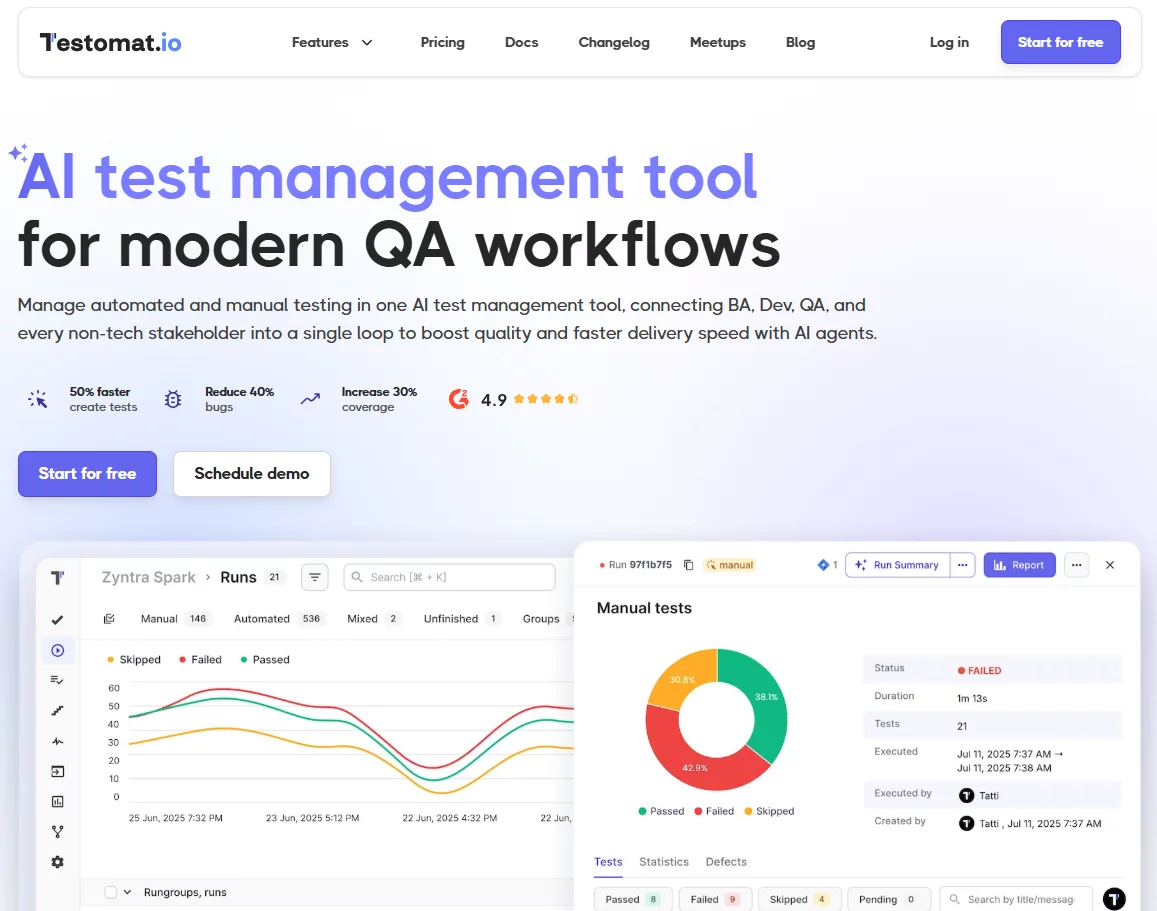
Testomat.io is a comprehensive cloud test platform that goes beyond simple test case management. It’s designed specifically for modern QA teams who need:
- AI-powered test generation from requirements
- Seamless integration with development tools (Jira, GitHub, GitLab)
- Automation framework support (Playwright, Cypress, WebdriverIO, Selenium)
- Real-time collaboration features
- Cloud-based accessibility with no installation required
Unlike generic project management tools adapted for testing, Testomat.io is built from the ground up as a cloud testing automation tool with QA workflows in mind.
🔎 Read also: Top Cypress Alternatives: Why Testomat.io Should Be on Your Radar
Core Capabilities of This Cloud Testing Tool
1. AI-Powered Test Case Generation
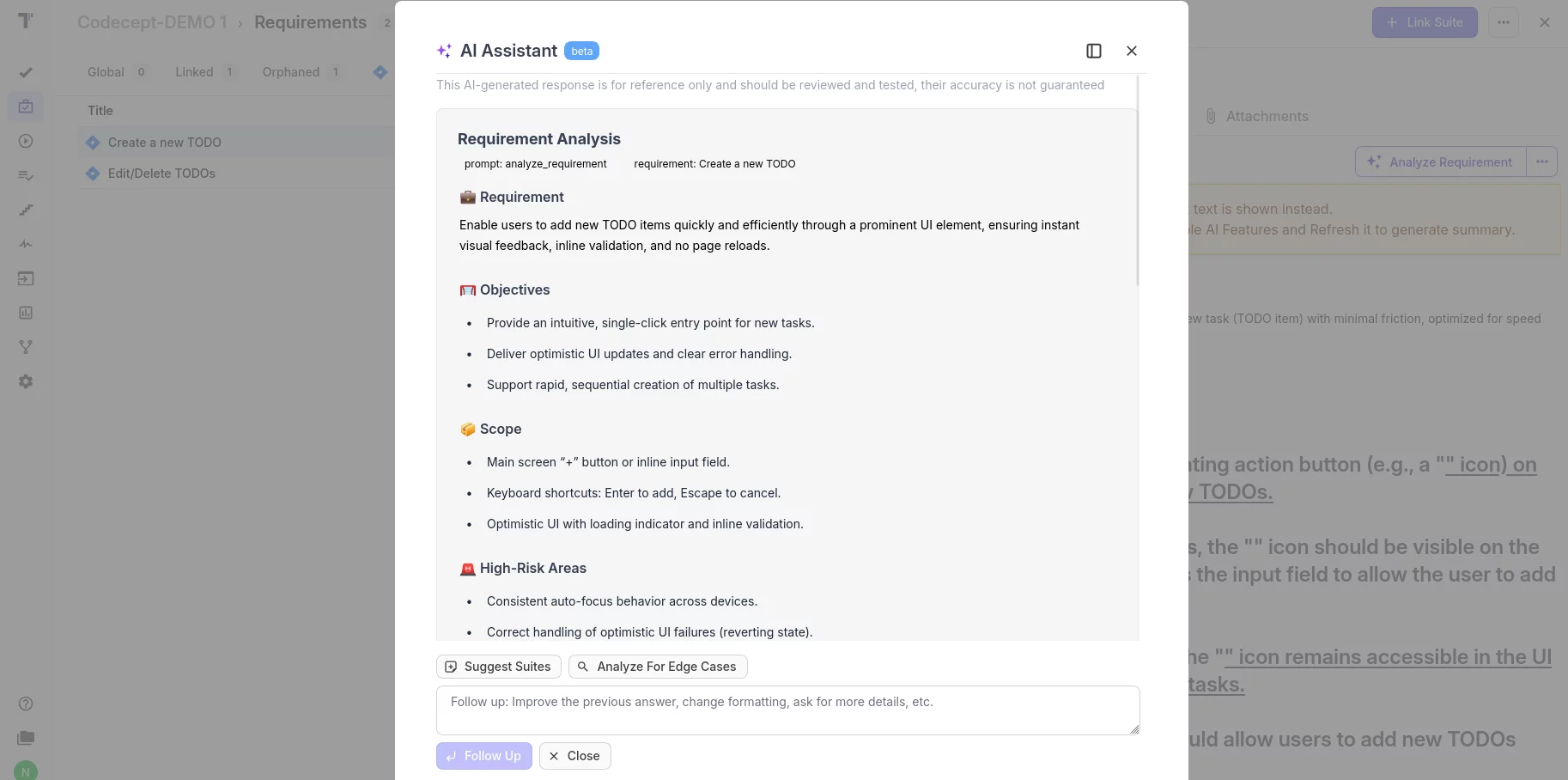
One of Testomat.io’s most powerful features is its ability to generate test cases using built-in AI.
Your requirements might come from:
- User stories and acceptance criteria
- Jira tickets linked to your project
- SRD/PRD documents uploaded to the platform
- Feature descriptions written by product managers
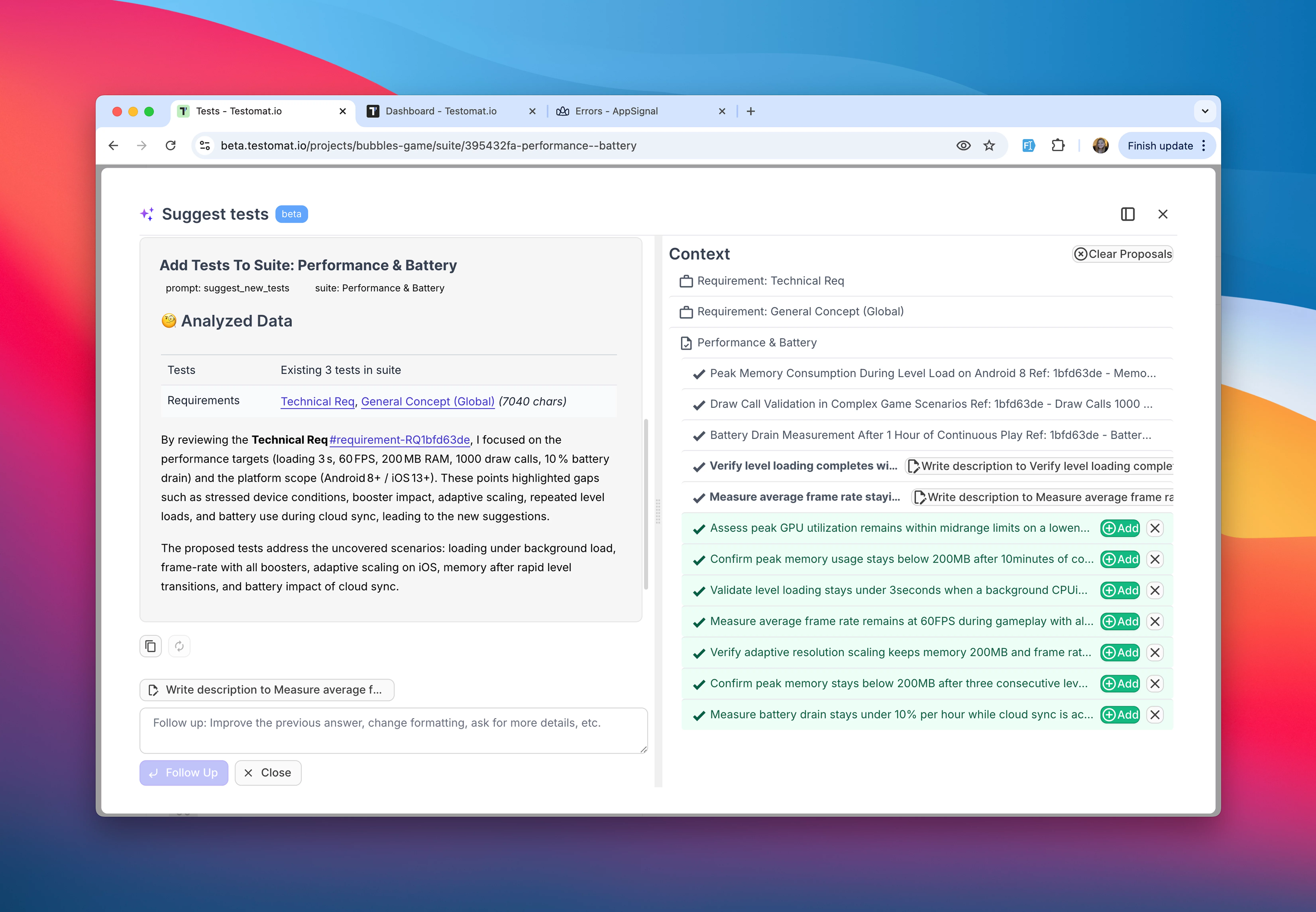
Simply select your requirement source, click “Suggest Tests,” and Testomat.io’s AI analyzes the content and generates relevant test scenarios automatically. The output includes:
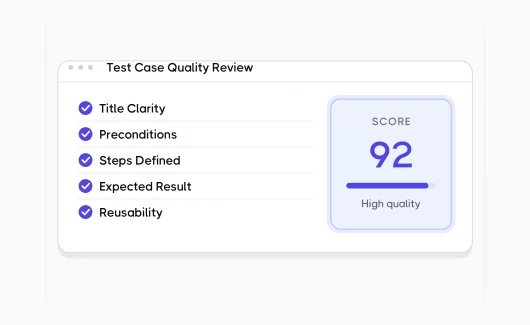
- Clear, structured test case titles
- Preconditions for each test
- Detailed test steps
- Expected results
- Suggested priority levels
- Relevant tags for organization
Generate Tests from Existing Test Suites
As your application evolves, you need to expand test coverage. Testomat.io can:
- Identify gaps in your existing test suites
- Suggest additional test scenarios you haven’t considered
- Recommend negative test cases and edge cases
- Auto-categorize and tag new tests based on your existing taxonomy
Generate Tests from Application Context
For web applications, Testomat.io can analyze:
- Application URLs (static page analysis)
- API schemas (OpenAPI/Swagger) to generate API test cases
- User workflows (onboarding → checkout → profile updates)
This cloud application testing tools approach ensures comprehensive coverage across all application layers.
2. Intelligent Test Description Generation
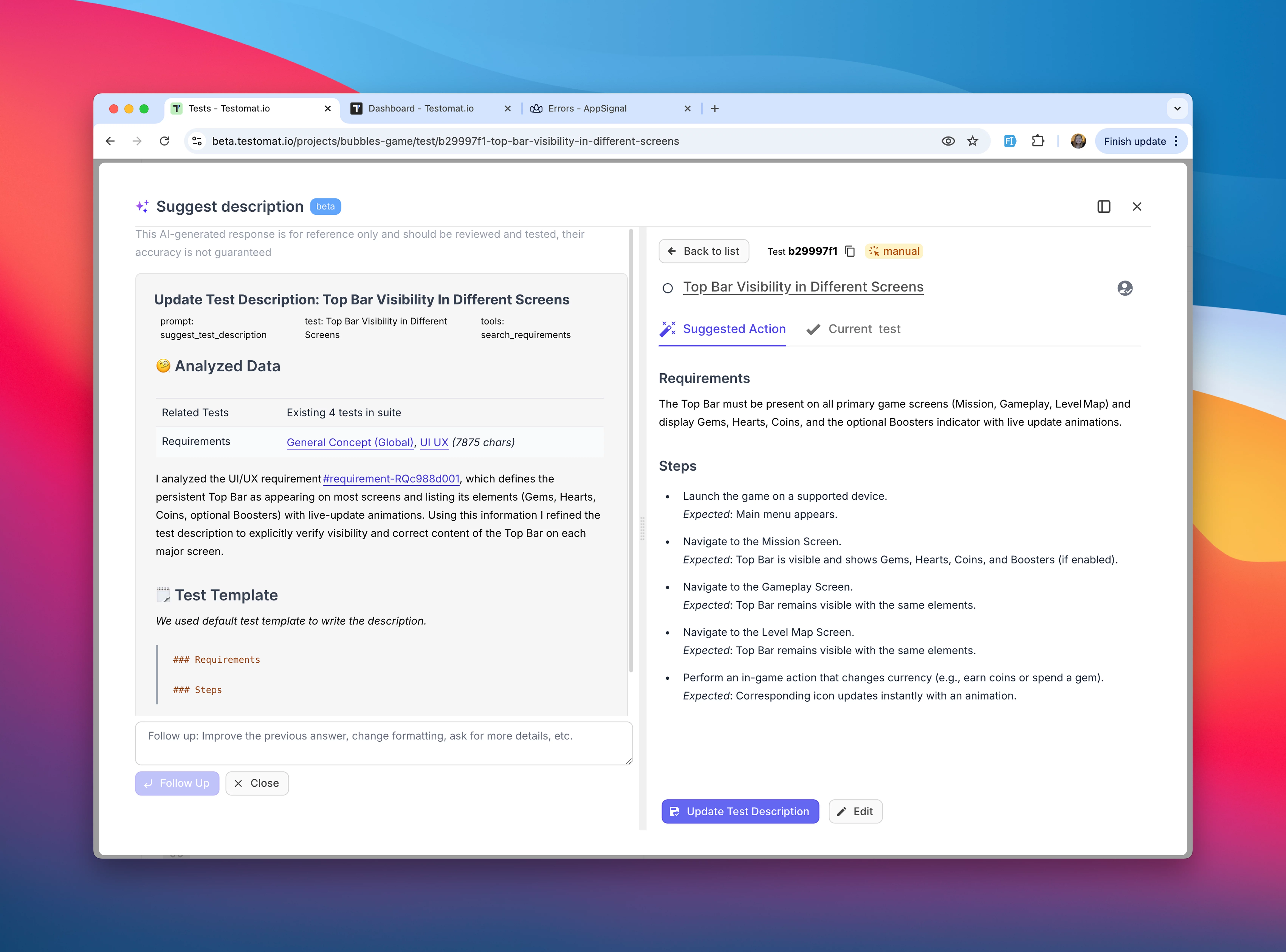
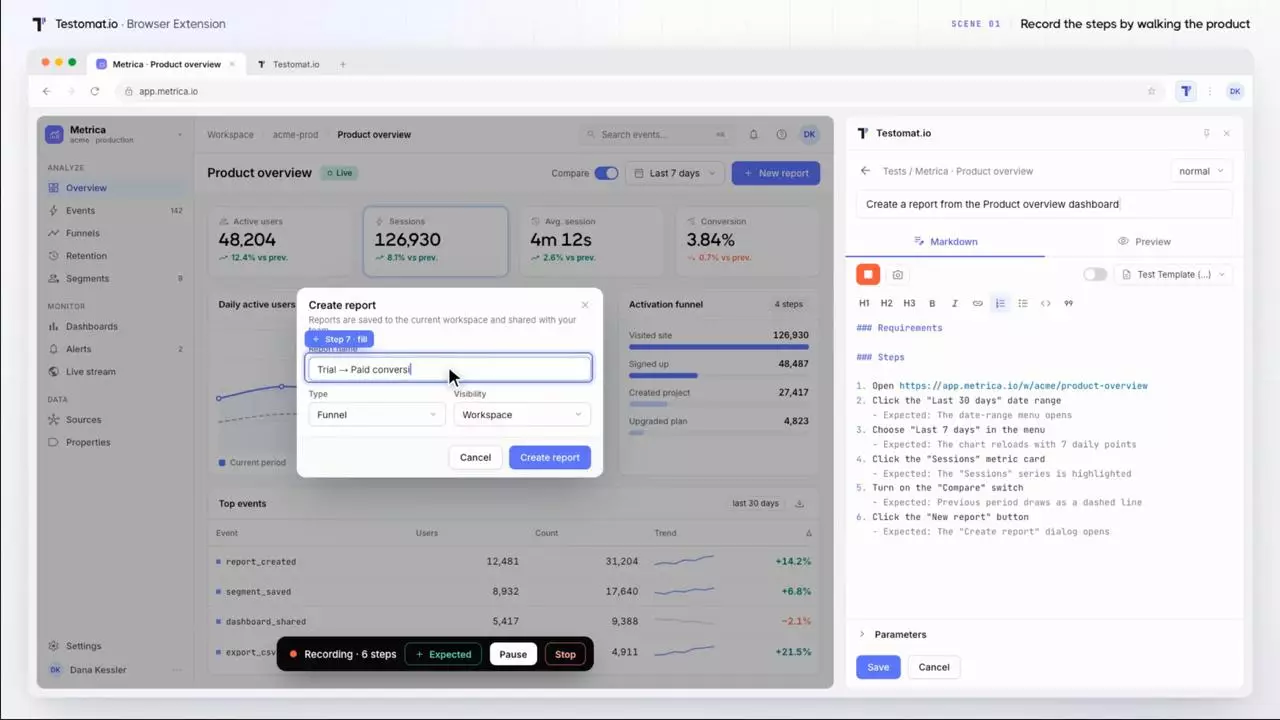
Once you have test titles, Testomat.io can expand them into complete, structured test cases. Click “Suggest Description” on any test, and the AI produces:
- Step-by-step instructions that are clear and actionable
- Expected results for each step
- Consistent formatting that matches your team’s standards
If the AI generates something incomplete or incorrect, you can manually edit and save, no lock-in, no risk. This cloud testing tool adapts to your workflow, not the other way around.
3. Automation Code Generation
When you’re ready to automate, Testomat.io becomes a powerful cloud test automation tool. Using the “Code by Description” feature, you can generate automation scripts based on existing test descriptions.
The generated code is tailored to:
- Your programming language (JavaScript, TypeScript, Python, Java, C#)
- Your chosen framework (Playwright, Cypress, WebdriverIO, Selenium, CodeceptJS)
- Your project structure (including Page Object Model patterns)
This eliminates hours of boilerplate coding and lets automation engineers focus on business logic instead of scaffolding.
Cloud Testing Services: The Complete Workflow in Testomat.io
Let’s walk through how modern QA teams use Testomat.io as their primary cloud based testing platform.
Step 1: Requirement Analysis and Import
Instead of manually copying requirements from Jira or documents, you can:
- Link Jira projects directly to Testomat.io
- Import requirements from tickets automatically
- Upload documents (PDF, DOCX, TXT) containing feature specifications
- Use existing test cases as input for expansion
The cloud testing platform maintains full context about your project, existing test suites, components, tags, naming conventions, and automation links.
Step 2: AI-Powered Test Generation
With requirements in place, initiate AI test generation:
- Select your input source (Jira ticket, document, URL, or existing tests)
- Choose test types you need:
- Functional tests
- Regression tests
- Negative test cases
- Edge case scenarios
- API test cases
- UI step-by-step tests
- Let AI generate structured test cases automatically
The AI understands your project context and produces tests that match your existing workflow.
Step 3: Review, Edit, and Organize
Generated tests appear in review mode where you can:
- Accept, reject, or modify individual test cases
- Bulk edit multiple tests simultaneously
- Add comments and collaborate with team members
- Organize into suites and assign to specific team members
- Link to requirements and Jira issues for traceability
This cloud testing automation tools approach ensures quality while maintaining speed.
Step 4: Connect to Automation Framework
Once test cases are finalized, Testomat.io connects seamlessly with your automation framework:
- Install Testomat.io reporter in your project (npm/pip package)
- Synchronize tests between your code and the cloud platform
- Run automated tests and send results back to Testomat.io
- Track execution history and analyze trends
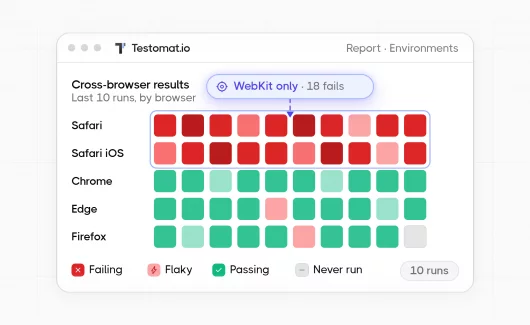
You get complete visibility: which tests are manual, which are automated, which are flaky, and which need attention.
Step 5: Continuous Testing in CI/CD
As a cloud automated testing platform, Testomat.io integrates with:
- GitHub Actions
- GitLab CI
- Jenkins
- CircleCI
- Azure DevOps
- Any CI/CD system via API
Automated tests run on every commit, pull request, or scheduled build. Results flow directly into Testomat.io where your team can review them.
Types of Cloud Testing Tools
There are also cloud performance testing tools like:
- K6 (load testing)
- JMeter (performance testing)
- Gatling (stress testing)
You can track performance test results alongside functional tests, giving your team a complete picture of application health.
Cloud Penetration Testing Tools
Security is critical. Testomat.io allows teams to document and track security testing efforts, including results from cloud pen testing tools like:
- OWASP ZAP
- Burp Suite
- Nmap
Document security test cases, link them to requirements, and track remediation efforts –all in one place.
Cloud Load Testing Tools
For applications that need to handle high traffic, cloud load testing tools are essential.
- Plan load testing scenarios
- Document performance requirements
- Track load test execution results
- Analyze performance trends over time
What Are the Best Cloud Automation Testing Tools?
The best cloud automation testing tools depend on your stack. For test management and AI-driven test generation, Testomat.io works as a cloud test tool that ties everything together. For the automation layer, teams pair it with a cloud test automation framework such as Playwright, Cypress, WebdriverIO, or Selenium. Cloud based automation testing tools like these run your suites in CI/CD and report results back in one place.
Key Advantages of Cloud Based Testing Services
1. Context Awareness vs. Generic AI Tools
Generic AI assistants (like ChatGPT):
- Have no context about your project
- Treat every request as new
- Produce generic output requiring extensive editing
- No awareness of existing tests, naming conventions, or workflow
Testomat.io (cloud testing platform):
- Understands your entire project context
- Knows your existing test suites, components, and tags
- Follows your team’s naming conventions
- Suggests tests that fit your actual workflow
- Identifies duplicates and coverage gaps
2. Structured, Consistent Output
Generic AI tools:
- Output varies based on how you phrase prompts
- Requires manual formatting every time
- No guarantee of consistency across team members
Cloud test platform like Testomat.io:
- Every generated test follows the same structure
- Consistent formatting across all tests
- Title, preconditions, steps, expected results, priority, tags, always included
- Immediately usable without reformatting
3. Seamless Tool Integration
Generic AI assistants:
- No direct integration with Jira, test frameworks, or CI/CD
- Everything requires manual copy-paste
- No automation connectivity
- No test execution tracking
Testomat.io (cloud automation testing tools):
- AI-generated tests automatically link to Jira stories
- Tests placed directly into appropriate suites
- Assigned to team members instantly
- Connected to automated test code
- Results flow to CI/CD pipelines
- Everything happens inside your workflow
4. Coverage and Duplicate Detection
Generic AI tools:
- No awareness of existing tests
- Can’t identify missing coverage
- No duplicate detection
- You must analyze everything manually
Cloud based testing tools like Testomat.io:
- AI checks for duplicates automatically
- Identifies missing scenario coverage
- Analyzes existing regression tests
- Suggests what’s missing, not just generates blindly
- Tracks which tests are automated vs. manual
5. Team Collaboration Features
Generic AI outputs:
- Static text with no collaboration capability
- No approval workflow
- No version history
- No audit trail
Cloud testing platform:
- Built-in approval workflows
- Version control for test cases
- Team commenting and discussion
- Complete audit log (“who generated what and when”)
- AI output becomes part of product lifecycle
6. Speed to Execution
Using generic AI:
- Generate content manually
- Copy to your tool
- Format appropriately
- Add missing fields
- Link to requirements
- Assign to team members
- THEN start testing
Using Testomat.io:
- One click → AI generates structured test suite
- Automatically formatted and organized
- Ready for execution or automation immediately
- No copy-paste, no reformatting needed
Real-World Use Cases for Cloud Testing Tools
Your team is building a new e-commerce platform with checkout, payment integration, inventory management, and user accounts.
Using Testomat.io as your cloud testing tool:
- Import requirements from Jira epics describing the checkout flow
- Generate functional tests covering happy path scenarios
- Generate negative tests for invalid payment methods, expired cards, etc.
- Generate edge cases like simultaneous purchases of last item in stock
- Create API tests from OpenAPI schema for payment gateway integration
- Generate automation code for critical checkout scenarios
- Connect to CI/CD so checkout tests run on every deployment
Result: Comprehensive test coverage achieved in hours instead of days.
Use Case: Mobile Banking Application
Scenario: Testing a banking app requires extreme precision and security focus.
Using cloud application testing tools:
- Document security requirements imported from compliance documents
- Generate security test cases for authentication, authorization, encryption
- Create performance tests for high-load scenarios (millions of users)
- Track penetration testing results from security auditors
- Maintain audit trail of all testing activities for regulatory compliance
Result: Complete traceability and compliance documentation in one platform.
Use Case: SaaS Product with Frequent Releases
Scenario: Your SaaS product ships updates weekly and needs robust regression testing.
Leveraging cloud automated testing:
- Maintain regression test suite that automatically expands with new features
- AI suggests new regression tests when existing tests are modified
- Automated tests run on every pull request via GitHub Actions
- Results tracked over time to identify flaky tests
- Team reviews failures collaboratively in the cloud platform
Result: Confident, rapid releases without quality degradation.
Comparison: Cloud Testing Tools vs. Traditional Approaches
| Feature | Traditional Desktop Tools | Cloud Testing Platform (Testomat.io) |
| Accessibility | Local installation required | Access from anywhere, any device |
| Collaboration | Email attachments, shared drives | Real-time collaboration, comments |
| AI Integration | None or manual prompting | Built-in AI for generation and analysis |
| Jira Integration | Manual export/import | Automatic synchronization |
| Automation Connection | No direct link | Direct integration with test frameworks |
| Test Coverage Analysis | Manual tracking | AI-driven gap analysis |
| Version Control | File-based, manual | Built-in versioning and audit log |
| CI/CD Integration | Complex setup | Native integrations available |
| Cost | High licensing fees | Flexible cloud pricing |
| Maintenance | IT overhead for servers | Zero maintenance (SaaS) |
Best Practices for Cloud Testing Tools
Start small
Don’t migrate everything at once. Choose one project or feature area, generate tests with AI, and evaluate results.
Define your test case structure
Ensure your team agrees on:
- Required fields for test cases
- Priority levels and what they mean
- Tagging conventions
- Naming standards
Leverage AI, but review everything
AI-generated tests are excellent starting points, but human review ensures accuracy and completeness.
Integrate early with automation
Don’t wait until you have hundreds of manual tests. Connect your automation framework from day one and build automated coverage as you go.
Use the platform for collaboration
Encourage team members to comment on tests, suggest improvements, and discuss edge cases directly in Testomat.io.
The Future of Cloud Testing Automation Tools
Deeper AI Integration
Expect cloud testing platforms to offer:
- Automatic test plan generation based on sprint goals
- AI-powered defect analysis (predicting which areas need more testing)
- Intelligent test suite optimization (removing duplicates, shrinking regression suites)
- Self-healing tests that adapt when UI changes
Enhanced Performance Testing in the Cloud
Cloud performance testing tools will become more accessible:
- Generate load testing scripts from user analytics
- Predict performance bottlenecks using AI
- Simulate realistic user behavior patterns automatically
Security-First Testing Platforms
Cloud penetration testing tools will integrate more seamlessly:
- Automated security test generation from threat models
- Continuous security testing in CI/CD
- Real-time vulnerability tracking and remediation workflows
No-Code/Low-Code Test Automation
For teams without extensive coding resources:
- Visual test builders that generate automation code
- Natural language test descriptions converted to executable tests
- Maintenance-free test automation through AI self-healing
Conclusion
The QA landscape has fundamentally changed. Teams can no longer afford to spend days analyzing requirements, manually writing hundreds of test cases, and struggling with disconnected tools.
Cloud testing tools, particularly comprehensive platforms like Testomat.io, represent the new standard for professional QA teams. By combining:
- AI-powered test generation for speed
- Structured test management for consistency
- Seamless integrations for workflow efficiency
- Real-time collaboration for distributed teams
- Automation framework support for comprehensive coverage
…these cloud-based testing services enable teams to work faster, smarter, and more effectively than ever before.
Whether you need cloud automation testing tools for functional testing, cloud performance testing tools for load scenarios, or cloud pen testing tools integration for security, modern cloud testing platforms bring everything together in one place. The combination of AI assistants (like ChatGPT) for creative acceleration and cloud test automation tools (like Testomat.io) for structured, workflow-integrated testing represents the optimal approach for 2026 and beyond.